Nº 000001 · CUT 2026-10-12 · THE RELAUNCH
AI chats, kept like records.
On your own keys, on your own machine, kept as files. No account with us. No history held hostage. Every conversation is a markdown record in a portable format you can carry anywhere.
PLATFORMSwebnowobsidiannowzed· q4 26vs code· q1 27jetbrains· q1 27
What you get
Your keys, your agents, every provider.
Your keys, your files
Keys live in your OS keychain — never with us. Conversations land as markdown plus the portable .curt file: one conversation, one file, re-importable on any machine.
Named agents
Agents that read, search, and edit your notes when asked — on a schedule, in swarms for big jobs, wired to your own MCP tools and the open Agent Skills standard, in and out of Claude Code.
50+ providers in the box
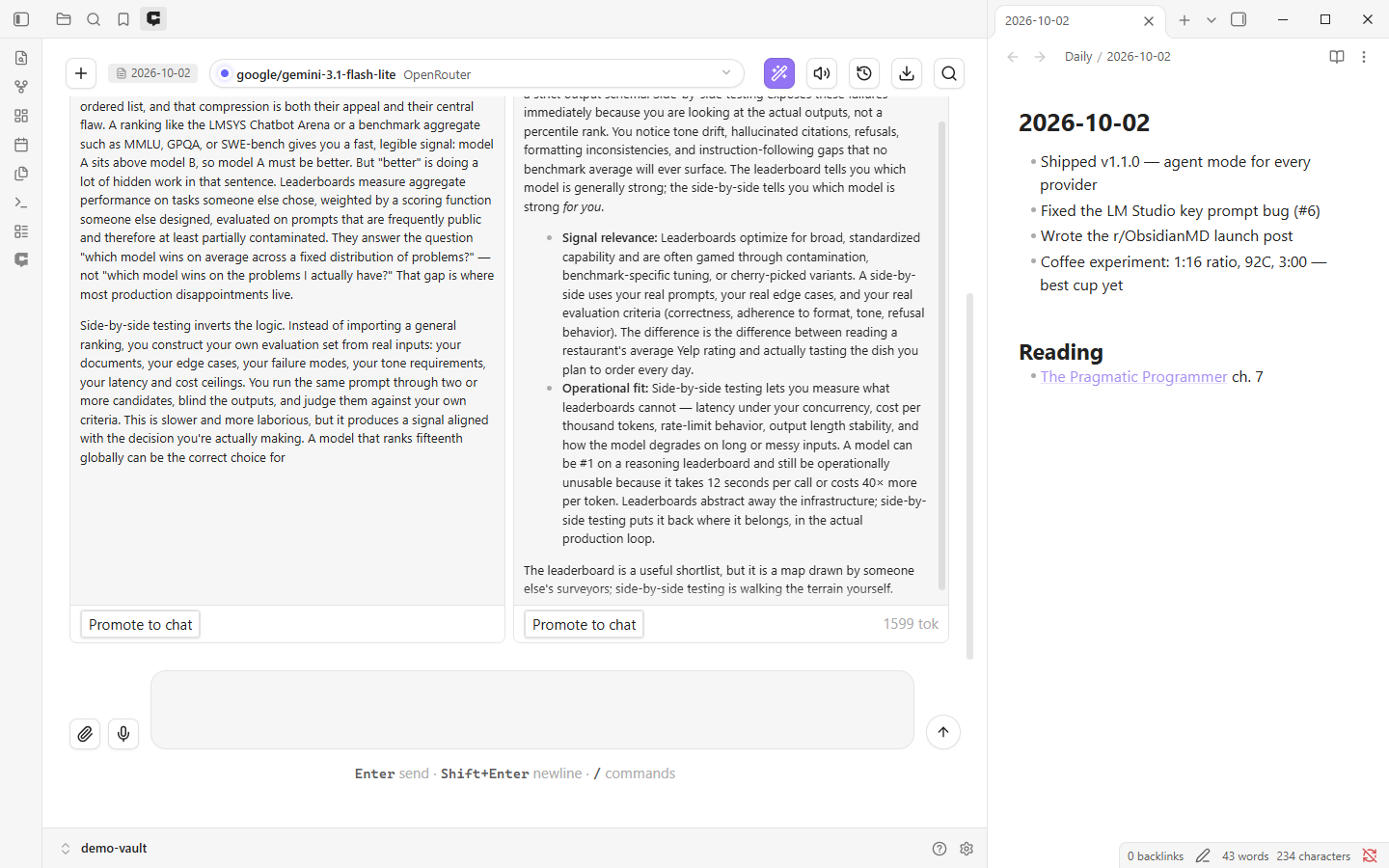
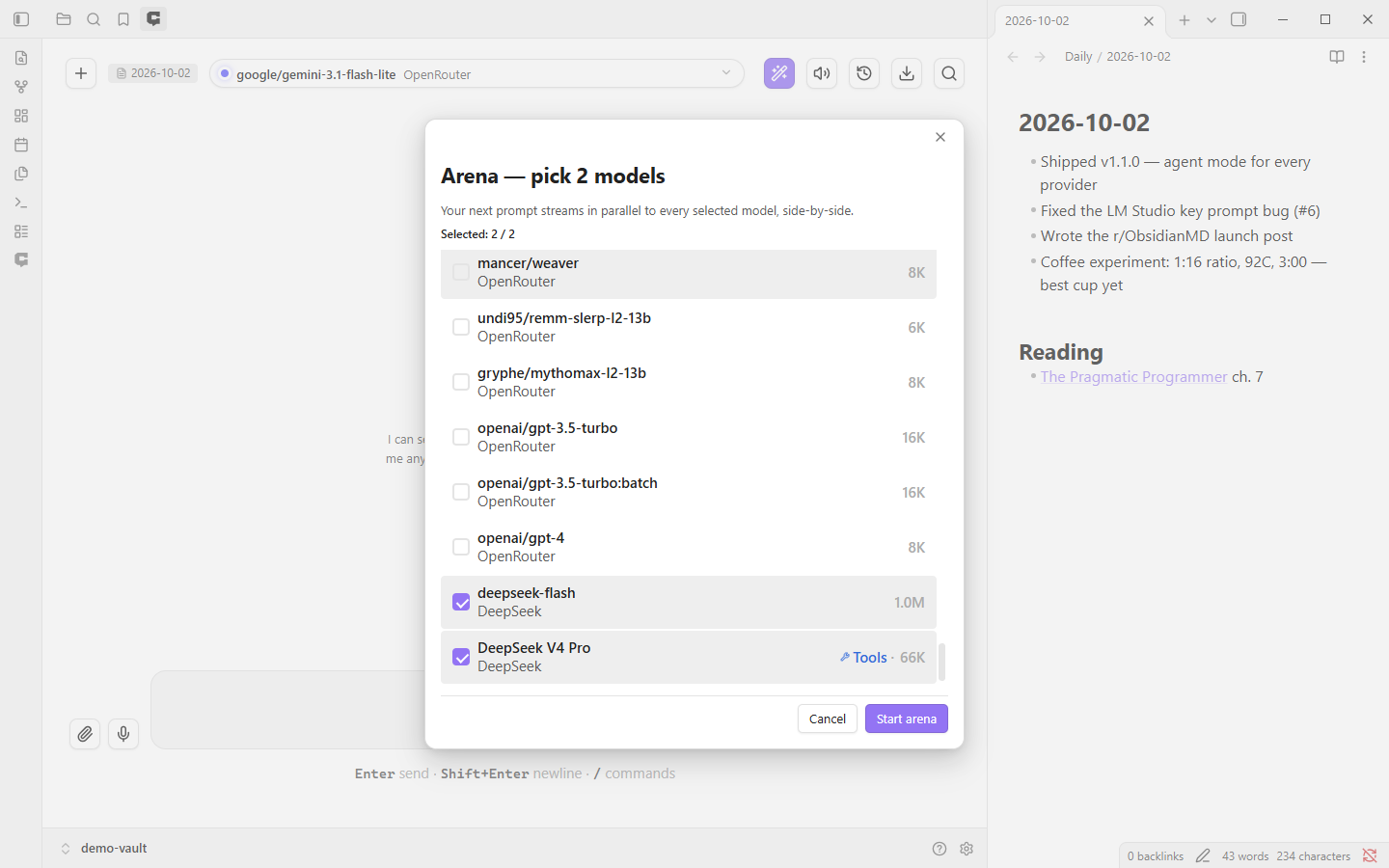
Every provider you already have — the labs, the aggregators, the runtimes under your desk — or any OpenAI-compatible endpoint. Compare up to four models side by side, attach images, talk and listen.
Two ways to talk.
What it does.
Chat with 50+ built-in providers — or any OpenAI-compatible endpoint — on keys you already have, stored in your OS keychain. Compare up to four models side by side. Attach images. Talk to it, and have it read back: neural read-aloud on your OpenAI key, dictation on Groq or any compatible endpoint.
Named agents read, search, and edit your notes when you ask, run on a schedule, spawn swarm specialists for big jobs, and connect to your own MCP tools — and Curtis can serve your notes as MCP tools to outside AI apps. Skills load from the open Agent Skills standard, in and out of Claude Code.
Every conversation is kept as markdown files you own, plus the portable .curt format: one conversation, one file, stable ids, re-importable on any machine.
Under the hood
The specification of record.
Straight from the release manifest and the changelog.
- release
- 1.0.0 — cut 2026-10-12, the relaunch (release notes below)
- providers
- 50+ built-in · any OpenAI-compatible endpoint welcome
- keys
- your own — OS keychain, stripped from backups
- agent tools
- 12 built-in — web search, url read, and the shell are opt-in
- open notes
- MCP server on localhost — token-gated, read-only by default · public plugin API
- retrieval
- hybrid — embeddings + BM25, rank-fused · optional on-device embeddings, no key
- formats
- markdown · .curt v1 — import, export, byte-perfect backup
- platforms
- Obsidian desktop + mobile · min app 1.13.0
- license
- BUSL 1.1 — source-available, free to use · Apache-2.0 four years after each release
Every provider you already have.
The labs, the aggregators, and the runtimes under your desk — all 50+ ship in the box, on your own keys. This is the manifest, straight from the release:
- Anthropic Claude
- OpenAI
- ChatGPT (Sign in)
- Google Gemini
- Z.ai Coding Plan
- Ollama (Local)
- LM Studio (Local)
- OpenRouter
- Groq
- Together AI
- Fireworks
- Mistral
- DeepSeek
- Cohere
- Vercel AI Gateway
- Meta Muse
- xAI Grok
- Perplexity
- Novita AI
- DeepInfra
- Chutes AI
- Replicate
- Hugging Face
- Azure OpenAI
- fal.ai
- Cerebras
- SambaNova
- Requesty
- NVIDIA NIM
- Moonshot Kimi
- Kimi for Coding
- MiniMax
- Alibaba Qwen
- Alibaba Coding Plan
- AI21 Jamba
- Upstage Solar
- Nebius
- Baseten
- Inference.net
- OVHcloud AI Endpoints
- FriendliAI
- GMI Cloud
- StepFun
- Tencent Hunyuan
- Z.ai GLM
- BytePlus ModelArk
- Baidu Qianfan
- SiliconFlow
- Crusoe Cloud
- Poe
- Featherless
- Scaleway
- Reka
Claude Pro/Max and GitHub Copilot sign-in are deliberately unsupported — those subscription plans don't permit API-style access, and we don't fake it. Kimi for Coding and the Alibaba Coding Plan work via a pasted plan key. ChatGPT plan sign-in is best-effort — OpenAI limits plan usage to open-source apps, and Curtis is no longer open source. The API-key path is unaffected.
There is no Curtis account and no sync service yet. Your conversations are files on your machine; syncing them is your sync tool's job. And scheduled runs execute inside Obsidian, so they fire while the app is running — a platform fact, so it is stated here.
Obsidian is the first platform — it shipped (v1.0.0, desktop and mobile), and the web console and the Porter CLI are live on this site. Zed rides Q4 26. The rest of the editor wave — VS Code, JetBrains, Neovim — is dated Q1 27. None of those exist yet, and nothing on this site claims support before it ships.
The record
What release 1.0.0 shipped.
Excerpted from the release notes. The full ledger lives in the changelog.
- agents
- named agents put any model to work — swarm specialists split the big jobs
- scheduled runs
- prompts on a cadence — each run lands as one markdown note
- terminal
- a pane and an opt-in command tool
- mcp server
- your notes serve as tools — Claude Desktop and coding agents work your files
- skills
- the open Agent Skills standard — round-trips with Claude Code, Cursor, Copilot
- import
- Claude Code setups adopt in one click — MCP servers imported disabled, subagents as named agents (remote invocation off), CLAUDE.md as a harness profile
- retrieval
- exact names and acronyms now match as reliably as meaning — BM25 fused with embeddings
- on-device
- the embedding index runs in Obsidian — no key, offline after a one-time ~30 MB download
- voice
- neural read-aloud + dictation — your key or Groq's whisper-large-v3-turbo
- harness
- pick the base contract under every prompt — the full Curtis contract, a plain assistant, or your own profile
- kept safe
- full backup/restore zip · outbound webhooks, metadata only
- providers
- 50+ built-in — plus any OpenAI-compatible endpoint as a custom provider
Receipts, not promises.
Curtis AI Audit, a sibling Obsidian plugin, keeps append-only receipts for agent activity — every inference, sequenced and checkable. Trust is a record you can check, not a feeling.